
AI continues to transform the job market and technology
From automation to strategic intelligence, Artificial Intelligence redefines professions, companies, and the global economy.
AI
Vitor Regis
6/2/20263 min read

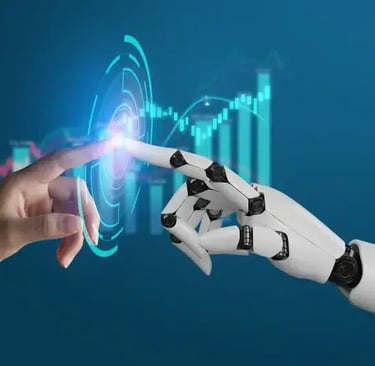
AI Continues Transforming the Labor Market and Technology
From automation to strategic intelligence, Artificial Intelligence is redefining professions, businesses, and the global economy.
Artificial Intelligence has evolved from a distant promise into one of the primary drivers of modern technological transformation. In 2026, companies across a wide range of industries are accelerating the adoption of AI-powered solutions, boosting productivity, automation, and the creation of new business models.
This movement goes far beyond the replacement of repetitive tasks. Today, AI serves as a strategic tool, assisting professionals in decision-making processes, data analysis, customer service, software development, marketing, and business operations.
Intelligent automation, once limited to operational functions, has rapidly evolved into systems capable of interpreting information, generating content, responding to complex requests, and collaborating with human teams in real time.
According to industry experts, the most significant shift is not necessarily the immediate disappearance of jobs, but rather the transformation of how work is performed.
Companies that previously relied on AI only for basic automation are now investing in intelligent agents, predictive analytics, and automated workflows designed to increase efficiency and competitiveness. This advancement is creating a new dynamic in the labor market: professionals who can effectively work alongside AI are becoming increasingly valuable.
At the same time, discussions surrounding workforce development continue to grow. The rapid expansion of AI technology has highlighted a global challenge related to digital skills and professional training. In many countries, businesses already identify the shortage of qualified professionals capable of operating and integrating AI systems as one of the main barriers to large-scale adoption.
Despite these concerns, experts caution against overly alarmist predictions regarding the complete replacement of the workforce. Real-world experience demonstrates that AI alone cannot solve organizations' structural challenges nor replace human qualities such as creativity, strategic judgment, leadership, and interpersonal relationships.
The emerging landscape points toward a hybrid model in which humans and machines work together in a complementary manner.
The economic implications are equally significant. The global AI market continues to attract billions of dollars in investments focused on computing infrastructure, specialized chips, and intelligent platforms. Expectations are that AI will become an essential component of 21st-century economic infrastructure, comparable to the role the internet played over the past several decades.
Industries such as healthcare, finance, education, logistics, and cybersecurity are already experiencing substantial changes driven by Artificial Intelligence. Simultaneously, governments and institutions are expanding discussions around regulation, privacy, and the ethical use of technology, seeking to balance innovation with responsibility.
The future of work, therefore, does not appear to be moving toward a fully automated environment, but rather toward a new relationship between human intelligence and computational intelligence.
More than eliminating jobs, Artificial Intelligence is redefining skills, creating new roles, and fundamentally changing how organizations operate and grow.
Companies that understand this transformation and invest in adaptation, workforce development, and technological integration are likely to secure a strategic position within the rapidly expanding digital economy.
Sources
• Tribuna do Sertão — “AI in Business: How Intelligent Automation Is Changing the Labor Market”
• MediaTalks/UOL — “AI and Your Job: What Has Really Changed, According to Experts”
• Hostinger — “Artificial Intelligence Statistics: 2026 Data and Trends”
Subscribe to our newsletter
Enjoy exclusive special deals available only to our subscribers.
Service
Company
Terms of Use
Contact
About the company
Terms and Conditions
Privacy Policy


Copyright © Vitor regis
são paulo, brazil
cnpj:66.825.015/0001-05